CALIFORNIA EPR · SB 54
California Just Rewrote the Economics of Flexible Film. Here's How GDB Circular Closes the Gap.
SB 54 turns a recycling shortfall into a multi-billion-dollar infrastructure mandate and a direct commercial opportunity for processors who can run film through an extruder.
On May 1, 2026, CalRecycle filed permanent regulations putting California's Plastic Pollution Prevention and Packaging Producer Responsibility Act — SB 54 — into force. The law has been six years in the making, delayed twice by Governor Newsom over cost concerns, and it is now live. For producers of flexible film packaging, the math is brutal and the timeline is short.
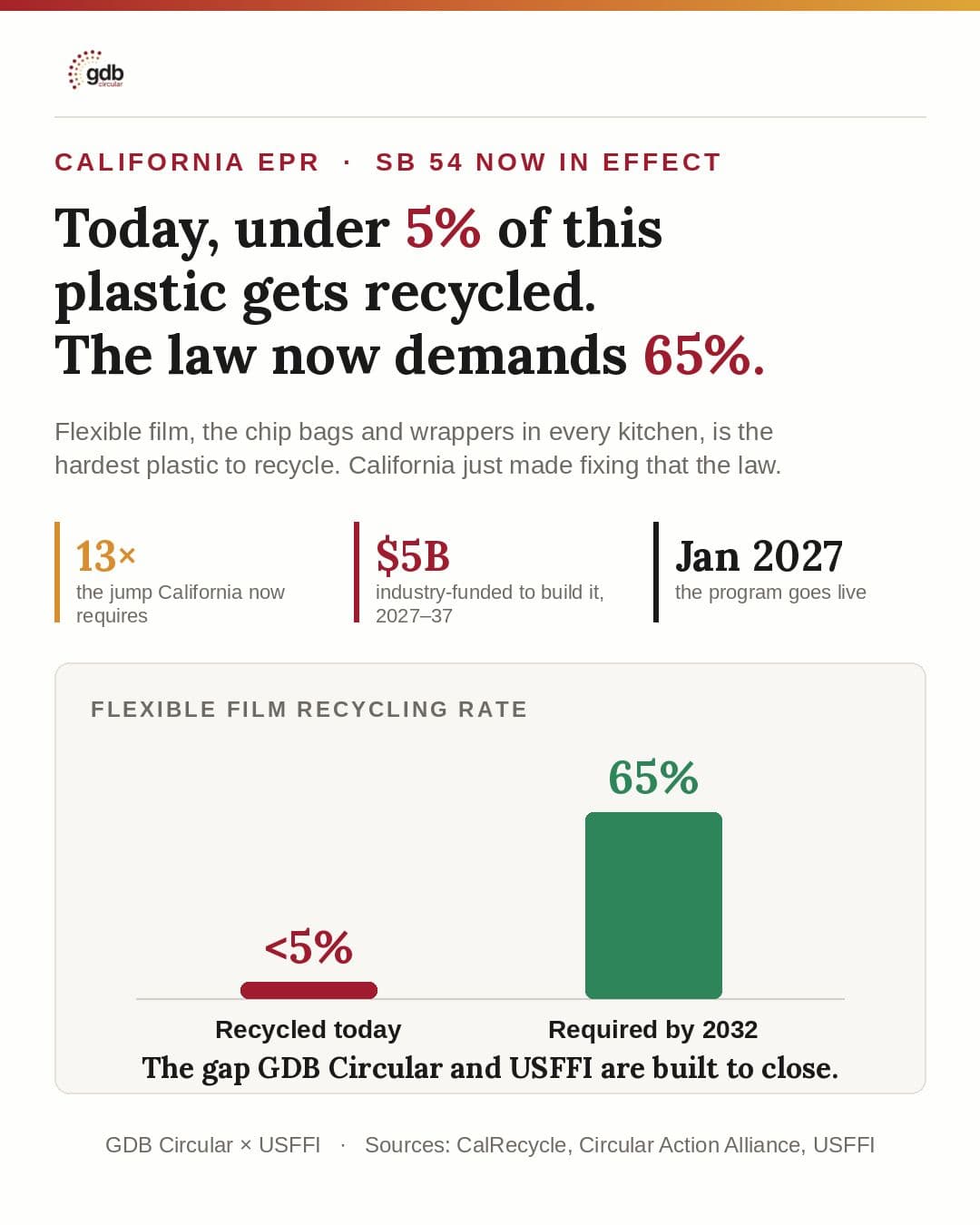
Today, less than 5% of flexible film and plastic packaging sold in California gets recycled. The law requires 30% by 2028, 40% by 2030, and 65% by 2032. That is roughly a 13x increase in performance, on a category — chip bags, pouches, multilayer wrap — that the recycling industry has historically treated as effectively unrecyclable.
Why This Is Different From Past EPR Rules
Most state EPR laws to date have been fee-and-reporting regimes: producers pay into a fund, a PRO redistributes it toward municipal recycling programs, and the material mix doesn't change much. SB 54 is structured differently and more aggressively, in three ways that matter to anyone running PCR capacity:
- Hard recycling-rate targets, not just funding obligations. By 2032, the PRO must hit 65% recycling on covered plastic material, producers must cut single-use plastic by 25%, and all packaging sold in the state must be recyclable or compostable. There is no fee that substitutes for actual tons recovered.
- Real money behind it. Roughly $5 billion in industry-funded capital is earmarked for infrastructure build-out between 2027 and 2037, administered through Circular Action Alliance, the state-approved Producer Responsibility Organization. That capital needs homes — washlines, extrusion capacity, sortation upgrades — and most of flexible film's current capacity in the US cannot absorb it.
- Escalating non-compliance penalties. Producers who can't demonstrate recyclability or use of recycled content face fines reported as high as $18 million per year per package category in industry analysis. CAA's plan, due to the advisory board in June 2026, with full program implementation beginning January 2027, will convert these targets into enforceable producer obligations on a fixed clock.
The Real Constraint: Capacity, Not Policy
Policy intent and physical capacity are two different problems. Film and flexible packaging is multilayer, often mixed-resin, frequently contaminated with food residue and paper, and historically uneconomic to sort and reprocess at scale. The Recycling Partnership and Circular Action Alliance have both said publicly that even a system performing at 90% efficiency across collection, sortation, and processing will barely clear the 65% target — because losses compound at every stage.
That is the gap GDB Circular is built to close. We are not a sortation pilot or a research grant recipient — we run commercial-scale washing and extrusion capacity (Erema, Lindner, Coperion lines) across NJ, MN, TN, FL, OH, and WI, processing HDPE, LDPE, and LLDPE film into resin that meets food-grade and FDA Letter of No Objection standards today. The bottleneck in flexible film EPR isn't ambition. It's processors who can actually take contaminated, mixed-stream film and turn it into spec-compliant pellets at volume.
Proof Point: The USFFI Pilot
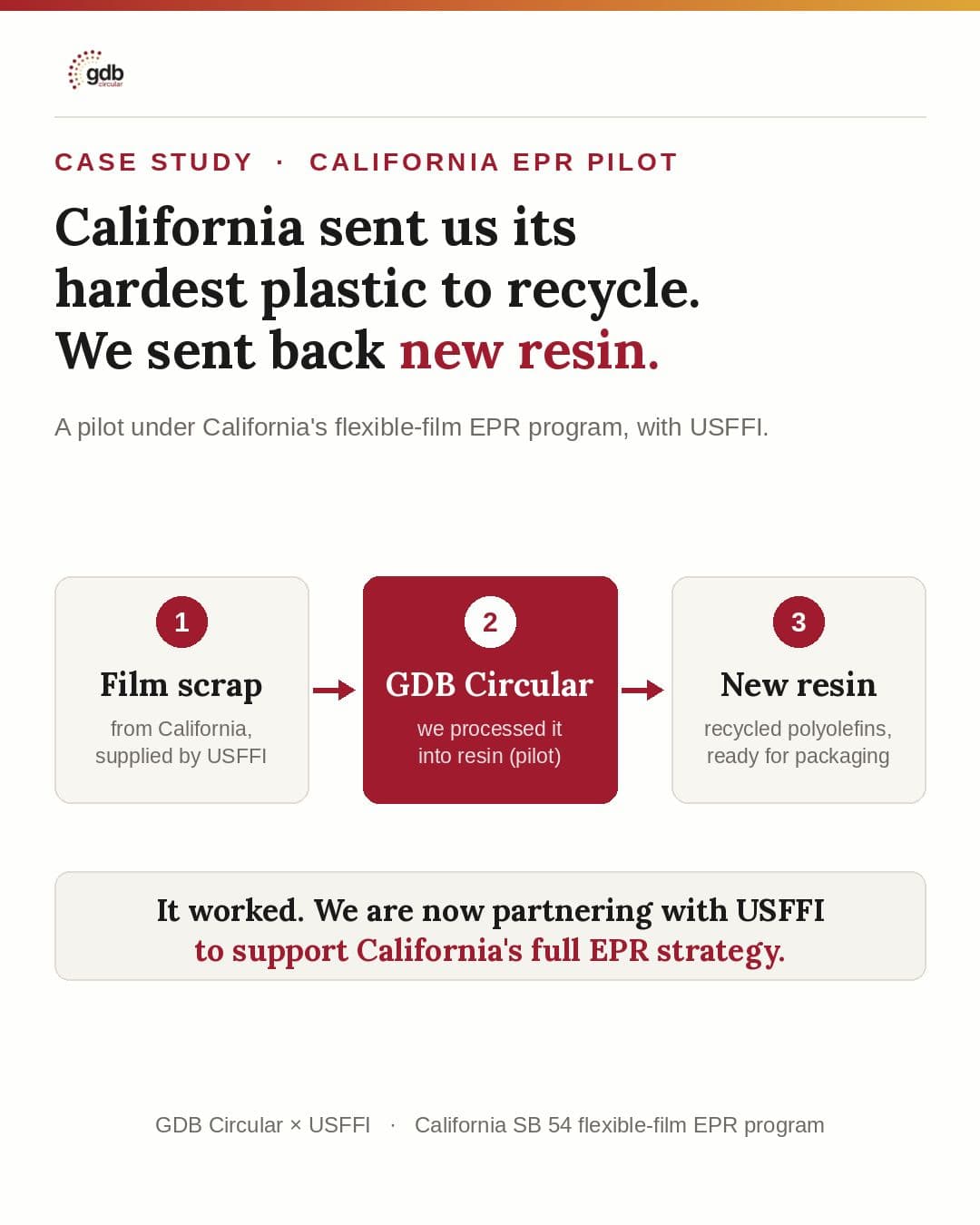
In partnership with the US Flexible Film Initiative — the brand coalition backed by General Mills, Mars, Mondelez, Nestle, Hill's Pet Nutrition, and PepsiCo, formed specifically to fund film recycling infrastructure ahead of SB 54 enforcement — GDB Circular ran a pilot taking film scrap sourced from California and processing it into new recycled polyolefin resin, ready for packaging applications.
The pilot validated something the policy conversation often skips: that California's hardest-to-recycle material stream can be converted into usable resin on existing commercial equipment, not just demonstrated in a lab. We are now structuring a full partnership with USFFI to scale that pathway in support of California's EPR strategy, positioning GDB Circular as one of the few full-coverage operators able to move from pilot tons to program tons.
What This Means for Brand Owners and Resin Buyers
SB 54's recycled-content cost curve is the clearest signal yet that virgin-only packaging strategies are becoming a financial liability in the country's largest consumer market.
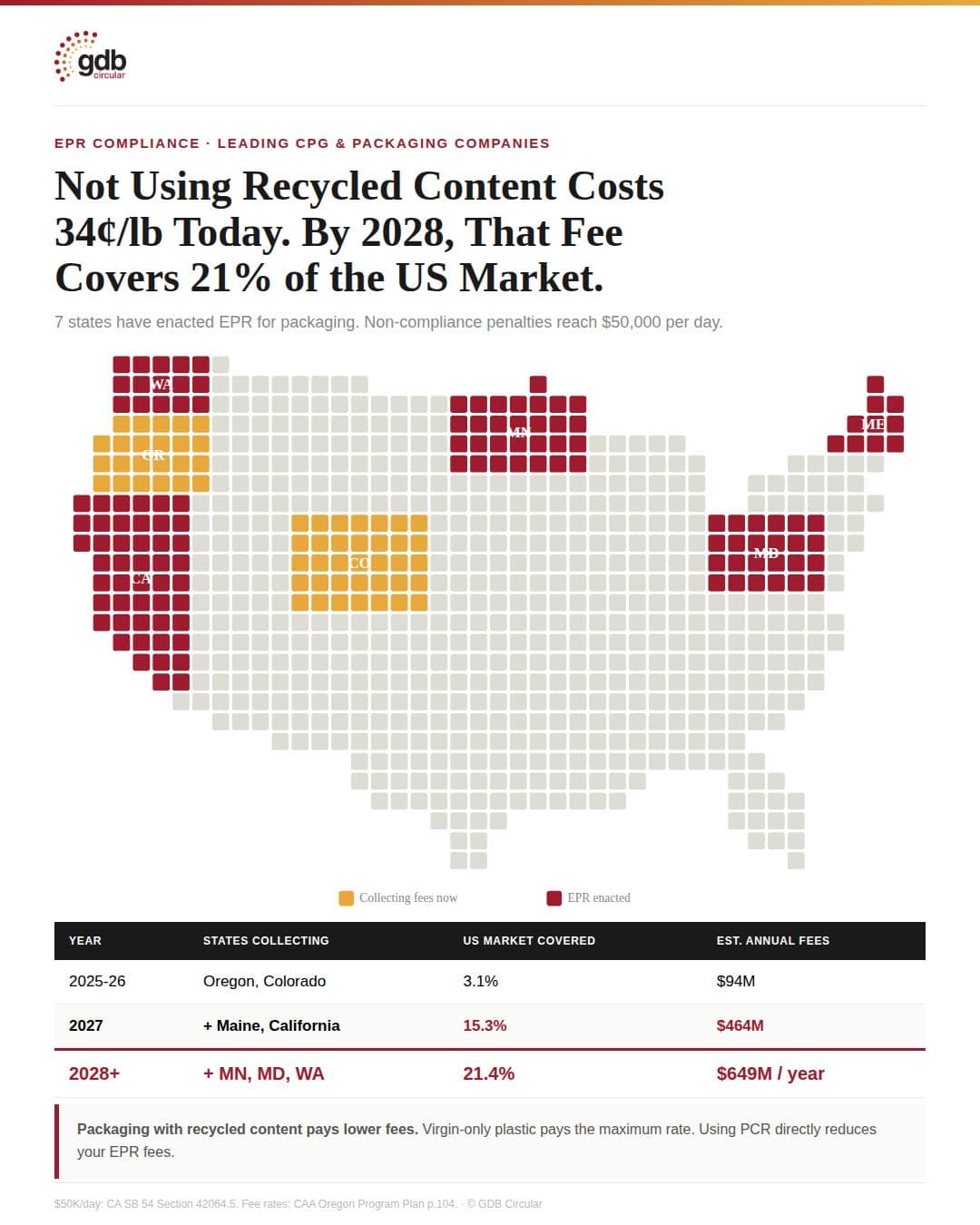
The practical takeaway: virgin plastic pays the maximum fee tier under these structures, while packaging with recycled content pays lower fees. For a CPG company selling nationally, California alone is large enough to force a packaging redesign decision — and the states layering in behind it make recycled-content sourcing a multi-state procurement issue, not a single-market compliance cost.
Where GDB Circular Fits
We sit at the intersection brand owners and PROs both need filled: certified, food-grade PCR resin production at commercial scale, across multiple feedstocks (HDPE, LDPE, LLDPE) and multiple geographies, with direct relationships into the regulatory and brand-coalition infrastructure — CAA, USFFI, CNG, General Mills, Schwan's — that is shaping how compliance actually gets operationalized.
As CAA's program plan moves from advisory board submission to full implementation in January 2027, the operators who can show real tons processed, real specs met, and real partnerships in place will set the commercial terms for the next decade of flexible film recycling in the US. GDB Circular intends to be one of them.
Sources: CalRecycle, Circular Action Alliance, US Flexible Film Initiative, The Recycling Partnership, Packaging Dive, Resource Recycling.